
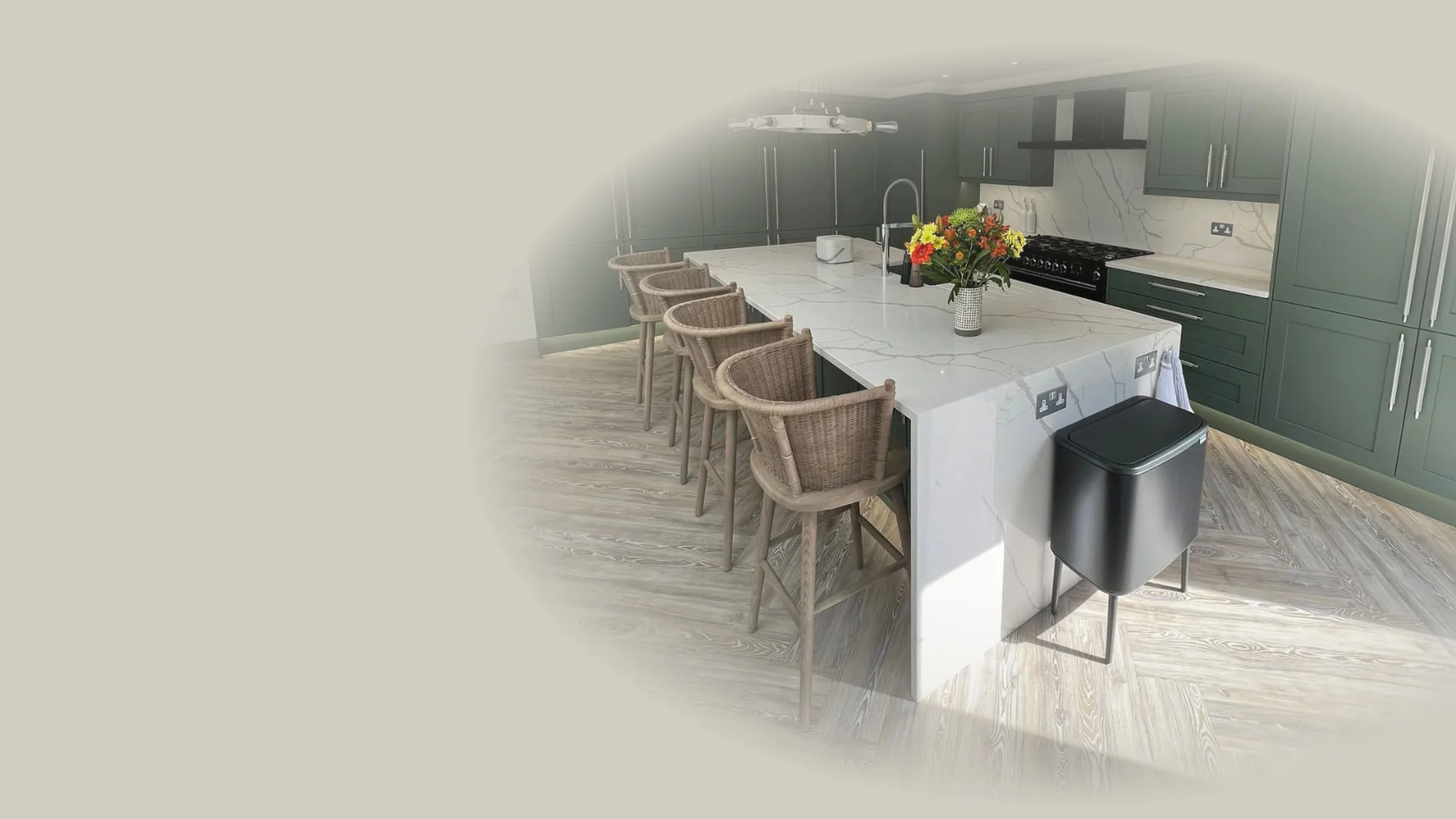
Almost every customer arrives having been told all three are "the best". They are not interchangeable, and the right answer depends on your kitchen rather than on which one a salesperson has most of in stock. Here is how the three families actually behave, and what we would tell you if you rang us and asked.
The short version
Quartz is the safe default for a busy family kitchen: non-porous, consistent, needs no sealing, and the widest choice of colours. Granite is quarried stone with real character and excellent heat tolerance, at the cost of periodic sealing and slab-to-slab variation. Sintered surfaces like Dekton are the toughest of the three and the only one you can put in direct sunlight without worrying, but they are harder to fabricate and that shows in the labour.
All three will outlast the kitchen units underneath them if they are fitted properly. Most of the difference in how happy people are five years later comes down to the fabrication and installation, not the material choice.
Quartz: engineered, predictable, forgiving
Engineered quartz is ground natural quartz bound with pigment and a polymer resin, pressed and cured into slabs. Because it is manufactured rather than quarried, it is consistent: the sample you hold is a fair representation of the slab you get, and a long run stays uniform across joins. If you are matching a kitchen to a utility room, or fitting two rooms weeks apart, that consistency is the single most useful property on this page.
It is non-porous, so it does not need sealing, ever. Wine, oil, coffee and turmeric sit on the surface rather than soaking in, which is why it dominates family kitchens. It is hard enough that everyday use will not scratch it, though it is not scratch-proof and it will always beat a knife blade rather than the other way round.
The weakness is the resin. Resin does not like heat and it does not like ultraviolet light. A pan straight off the hob can scorch a pale quartz or, worse, cause a thermal-shock crack, so a trivet is not optional advice: it is the one rule quartz has. Slow cookers and air fryers left running directly on the surface are the modern version of the same problem. And because the resin yellows under UV, quartz is not a material for a conservatory, an orangery run in full sun, or an outdoor kitchen.
Choose quartz when
- It is a normal indoor family kitchen and you want to stop thinking about the worktop
- You want a specific colour, particularly a clean white or a marble-look vein, done consistently
- You are matching two rooms, or you have a long run where consistency across joins matters
- Nobody in the house is going to be reliable about sealing anything
Granite: quarried, individual, unbothered by heat
Granite is cut out of the ground and cut into slabs. Nothing is added to it, which is the source of both its advantages and its quirks. There is no resin in it, so heat is essentially a non-issue: a hot pan on granite is not the disaster it is on quartz. It is extremely hard, and dark granites in particular take a deep polish that engineered material struggles to imitate.
Because it is natural, every slab is different. Veining, background tone, flecking and movement vary between slabs and vary a great deal between batches. This is a feature if you want a worktop that is genuinely one of one, and a nuisance if you are trying to match a sample exactly. Treat a granite sample as an indication of colour and character, not a colour-match. Natural pitting and fine fissures are properties of quarried stone, not faults, and every reputable fabricator will tell you the same.
Granite is porous, to a degree that depends on the stone. It is sealed at fabrication and needs re-sealing periodically. How often depends on the stone and how hard the kitchen is worked, and there is a simple water test that tells you when. Lighter and more open granites need it more than dense black ones. If nobody in the house will ever do that twenty-minute job, be honest about it now and buy quartz.
Choose granite when
- You want a surface with genuine natural character rather than a repeating pattern
- Heat tolerance matters more to you than pattern consistency
- You are happy to seal it periodically and to test it occasionally
- You like the idea that nobody else has your worktop
Dekton and sintered stone: the tough one
Sintered surfaces are made by compacting mineral powders under very high pressure and heat, producing an ultra-compact material with no resin in it at all. That single fact drives most of what follows: high resistance to heat, high resistance to scratching, effectively zero porosity, and genuine UV stability. It is the only one of the three we would specify for an outdoor kitchen or a run that sits in permanent direct sun under a rooflight.
It is also available in thin gauges, which is why it looks so good as a mitred edge. A 12mm or 20mm slab folded down into a 40mm or 60mm apron gives a sharp, architectural profile that reads as solid stone. On a dark island with a rooflight above it, a one-piece sintered top with a mitred apron is about as good as this trade gets.
The trade-offs are real. Sintered material is hard on tooling and slow to cut, which shows up in the fabrication labour rather than the slab price. Its hardness makes it more brittle at unsupported edges, so overhangs and cut-outs need designing properly. This is not a material to hand to a fabricator who is learning on your kitchen. And the mitred detail everyone wants is skilled work, which is exactly the kind of thing that separates a good quote from a cheap one.
Choose sintered stone when
- The surface will see direct sunlight, or it is going outside
- You want a fine mitred edge or a very thin profile
- The kitchen gets hard use and you want maximum durability
- You are fitting a dark, low-sheen island where every mark would otherwise show
Side by side, on the things that differ
| Quartz | Granite | Sintered / Dekton | |
|---|---|---|---|
| Sealing | Never | Periodically | Never |
| Hot pan straight on it | No: use a trivet | Tolerant | Highly tolerant |
| Direct sunlight | Avoid: resin yellows | Fine | Fine, UV stable |
| Pattern consistency | High | Varies slab to slab | High |
| Scratch resistance | Good | Very good | Excellent |
| Chip risk at edges | Low | Low | Needs careful detailing |
| Colour choice | Widest | Nature decides | Broad, strong on darks |
| Where the cost sits | Slab price | Slab price | Fabrication labour |
On price
Material across all three runs from £110/m² supply to around £550/m² supply, and the bands overlap heavily. There are granites cheaper than mid-range quartz and sintered surfaces cheaper than premium quartz. Material is only one input into the final figure. Cut-outs, edge work, joins and access matter just as much, which is why we quote the job rather than the metre.
What we would say if you rang us
For a standard indoor family kitchen with a hob run and an island, quartz is the answer nine times out of ten, and the argument is about which quartz rather than which material. If you cook heavily and like the idea of stone that is genuinely unique, granite is a better fit and the sealing is less of a chore than the internet suggests. If there is a rooflight, a glazed extension, an outdoor run, or you have set your heart on a thin mitred edge, sintered stone earns its extra fabrication cost.
What we would not do is let you buy the top of a range because it is the top of the range. There are cheaper slabs in every family that behave identically in a domestic kitchen, and the difference is pattern rather than performance. Ask us and we will tell you where you are paying for looks. It costs us margin and saves you the conversation you would otherwise have in three years.
Order samples of the two or three you are seriously considering and put them on the units in your own kitchen. Look at them in daylight, then at night under your downlights, then with the door of the room you actually walk in through open. Half the colours people fall in love with on a screen are the wrong tone in the room, and a sample costs you nothing to find that out.
The short version
- Quartz for consistency and low maintenance, but always use a trivet and never in direct sun
- Granite for heat tolerance and natural character, at the cost of periodic sealing
- Sintered stone for durability, UV stability and thin mitred edges, at the cost of fabrication labour
- The bands overlap on price: material is one input, not the whole quote
- Look at samples in your own kitchen, in daylight and under your own lights